Category Archives: Uncategorized

The Emerging AI Hallucination đź§ 

After a recent presentation to senior and C-suite leaders across multiple industries on how AI is re-shaping work I find the conversations lead to extremes… From we are all in to>>> we do not know how to get started👣.
It’s also ( yes, still surprising) when I hear people with the attitude that AI will NOT CHANGE HOW I WORK. AI will not initially replace… but it will separate and re-organize those that leverage this advantage and those that do not.

The disruption rarely looks like replacement anyway. It looks like compression. Tasks that took a week take a day. Teams of five become two. The people who don’t adapt don’t get fired immediately — they just become visibly less productive relative to peers who are augmenting aggressively.

There’s also a status dynamic worth naming: for knowledge workers, the process of work has always been tied to professional identity. Admitting a tool can do in 20 minutes what took you two days is psychologically costly. So people find reasons to discount it.

The people most confident AI won’t change how they work are often constructing the most elaborate reasoning to avoid finding out.

And when entire leadership teams share the hallucination? You get companies treating AI as a productivity “side hustle” — tools at the margins, workflows unchanged — while competitive exposure quietly accumulates.


The “telephone game” with One Source of Truth

Remember the telephone game as a kid?

One person starts with a simple phrase…
“Butterfly.”

It gets whispered from person to person…
slightly altered each time.

By the end of the line?

“Whitewall tires.”

Same starting point.
Completely different outcome.

That’s exactly what happens to data inside many organizations.

We start with a single source of truth — the ERP.
But as it moves across functions…

Finance adjusts it.
Sales reshapes it.
Supply chain redefines it.
Marketing reinterprets it.

Each step makes sense locally.
But collectively?

We’ve turned “Butterfly” into “Whitewall tires.”

And now…

• Revenue doesn’t match across reports
• Volume tells a different story depending on the team
• Trade spend and margin are constantly debated
• Meetings shift from decisions → to reconciliation

This is the translation layer problem.

Not a data issue.
A consistency issue.

Because every transformation layer — no matter how well intentioned —
introduces drift between the business and the truth.

The organizations that break this cycle focus on:

âś” Shared definitions across functions
âś” Governed semantic layers (not just raw data)
âś” Alignment on metrics before analysis begins
✔ Reducing “local logic” in favor of enterprise logic

Because the goal isn’t just a single source of truth…

It’s a shared understanding of that truth.

Otherwise, you’re just playing telephone —
and wondering why your “Butterfly”
turned into “Whitewall tires.”

#DataGovernance #DataStrategy #Analytics #BusinessIntelligence #Leadership #DataGene #BeCurious

Data agility…What makes it difficult?

jumbled data

uhhh…. In a nutshell it’s driven by data variety.  (Not just the composition of data but also varied sources)

But what does that look like? Let’s say in Company “A” the sales department would like to analyze some sales data on Product “X”.  OK easy right? you pull a (insert data source here) shipment report, pick some date ranges, and run your report.  But now a spike in a given time frame prompts some additional questions… Why did that happen? What drove the increase? How does that compare to last year, last quarter, last period? Was it one or more sales divisions, customers, geographical areas? and the “WHY’s” create an avalanche that leads to… WE NEED MORE DATA!!!!!

Marketing suggests running a media spend report for some correlation to advertising activity. Someone else prompts looking at retail sales for the identified product across your re-sellers or retailers.  Your Social Media team wants to contribute data on FB “Likes”, Engagement, customer digital behavior, and NOW it’s gets interesting…  different departments, different systems, different data formats, different report layouts, different data outputs (csv, pdf, xls, mht) and on and on and on. Plus you now have different business stakeholders all with a slightly different “end game” in mind with regards to the business insight objective.

Is everyone seeing what’s different?

Here is one of my favorites… you have some key metrics you’d like to plot across time on a line graph.  However, for each metric (on each report) the date is different in both format and frequency.  Your sales report is weekly i.e. w/ending x/xx/xxxx.  Your finance report is monthly Month/Yr. Your Social Media report is daily Mon xx/xx/xxxx. Your shipment report is weekly but the format is week end Mnth/Yr XX:xx 00 sec AM/PM. Remember you just wanted to compare some values across time, apply a little business intuition and make some fact based recommendations.  Now your tasked with somehow becoming an overnight data scientist with a little shared time on the CRAY super computer.

And so this plays out week after week from front line administrators, mid-level managers, analysts and executives.  Each wanting actionable insight backed by data, analysis and confidence.  There are some free on-line tools that can help, as long as you don’t mind your results being PUBLIC.  There are also a bevy of “drag and drop” analytics tools to choose from and these can provide a degree of relief to situations outlined above.

What’s your favorite example of something starting easy only to get beyond difficult?


Why “information intimacy” is so important

In my experience, as an analyst, tool builder, sales person and data visualizer, I have seen this one component make such a huge difference. Information intimacy is the term I use to describe the series of insights (intimacy) you gain from the entire data exploration journey. From data collection, cleansing, organization, observation, analysis, metric development, statistical evaluation, cognitive inquiry to eventual data visualization, this “journey” sets the backbone for a high impact narrative.

Key Learning: Presenting insights from data that your audience is already aware of can initially help your credibility.  It let’s them know that you know a little about what they know.  THAT”S IT!!!  However, presenting information/insight they don’t know  really grabs their attention. People really listen when you say what they don’t expect to hear. Not my quote but incredibly accurate at describing interactions between presenters and presentees.

While you can always take a few select members of your analyst team with you (PLEASE DO THIS), the Sales Person is still responsible to tell a compelling story that keeps the audience engaged, interested and intrigued.  Just as you would not want a traditional sales person running your SPSS or SAS model you probably do not want your analyst talent being your sales person.  

So how do you transfer this intimacy from source to seller?

The model that’s evolving to meet this need is really blurring the lines of traditional roles. I’ve seen analyst/statisticians that are extremely savvy when presenting information to clients and influencing opinions.  Sales people who are not content in being handed a power point  a few days before a presentation.  They will sit with the analyst team and get below the obvious observations and into the information relationships that aid in exploiting the provocative.  Plus the double threat, individuals who have formally held one role then transitioned into another. How many places have you actually seen this happen?

In the opening for this post I mention how important the data exploration journey is in the development of a high impact narrative.  I recently participated in a session at a conference  on “presentation skills using story telling.”  Remember NOT everyone absorbs information in the same way.  Your ground breaking, animated bubble quadrant with live data streaming theme clouds won’t always reach everyone.  But a data visualization with PUNCH, plus a great story creates an ideal landscape for comprehension.


So why intersections vs. an “analytics maturity curve?”

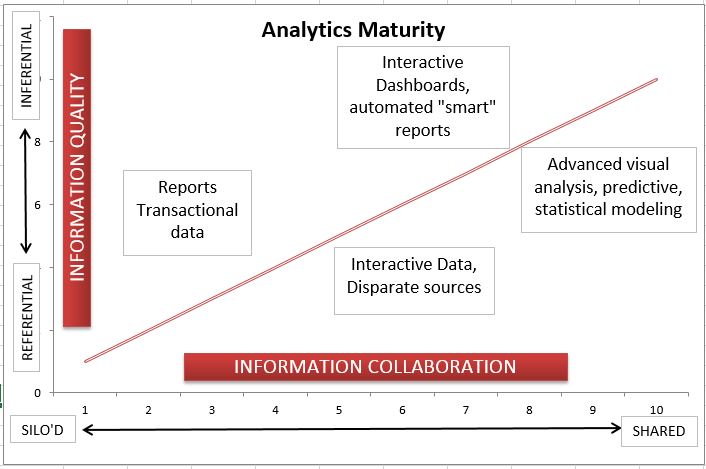
Even before BIG DATA and analytics was the buzzword of choice, organizations have been assessed and self assessed their own technological maturity.  This, in hopes, of understanding where they stand vs. their own industry vertical and peer groups.  No one wants to get left behind…  This humble beginning was relatively easy in comparison to the constant disruption of innovation we face today. Back then, technology around data management kept us following the rules so to speak.  Breaking out of the norm was either too risky, too expensive or lacked the C-suite backing to ever evolve from idea to implementation.  As the ability to collect, analyze and share information became easier and easier the early adopters paved the way, proving that having more data leads to more insight which can directly translate into tangible, measurable business results.    How fortunate during this evolution that data availability was exploding… internet, social media, machine and manufacturing data,  financial data, shipment data, public data, forum data and on and on and on.

So the primary visualization has been to benchmark basic to advanced along a “CURVE.”

Maturity curve

There are endless variations to the above theme.  All good and some very insightful. My only apprehension is the curve suggests a “point of completion”, a landing spot where we say “DONE.” Let’s check analytics off our to do list.  The disruptive nature of insight leads me to believe there is no finish line, there is no point where your done with analysis.  On the contrary, the better our analytics discipline, the better your range of inquiry becomes.  “You get progressively sharper as ASKING BETTER QUESTIONS!!!” And there are no end to the questions as we learn more from the data.  I prefer the crossroads and intersections metaphor because it keeps you moving forward without the idyllic conception of a destination.  Not that you can’t enjoy the respite of a few rest stops along the way.  Intersections do provide critical decision points along your journey that allow for adjustments and ensure results are meeting expectations.

Through this lens we can understand the key markers of progress along the journey.

The intersection of:

 crossroads

  • technology meeting talent
  • from data to information to insight
  • investment meeting innovation
  • reporting meeting interactivity, eventually interoperability
  • data visualization meeting clarity and creativity
  • solution vendors meeting partnerships
  • analytics results meeting business success
  • AND… where the passion for insight meets possibilities

Plus, there are so many more.

Crossroads and Intersections in analytics

Looking forward to providing a “view from the trenches” on analytics, business intelligence, reporting and BIG DATA throughout the coming weeks.  The first rule of blogging… stay current, blog often and be disruptive.  More to come…